

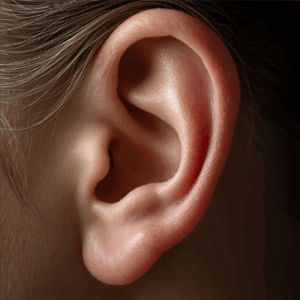
How the ear works
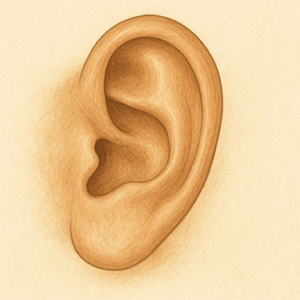
The outer ear consists of the pinna and the ear canal. Its role is to capture and amplify sound using the pinna, then transmit these vibrations through the ear canal to the eardrum. The outer ear also plays a role in localization and spatialization.
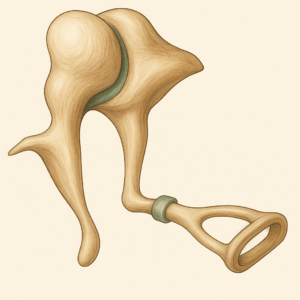
The middle ear amplifies and transmits sound vibrations from the air to the inner ear. When the eardrum vibrates in response to sound, it sets in motion the chain of three ossicles (the malleus, incus, and stapes).
This delicate mechanism amplifies the vibrations so that they can be effectively transmitted to the cochlea, a fluid-filled cavity where the sound is converted into nerve signals.
The middle ear also plays a protective role thanks to the stapedius reflex. When sounds exceed approximately 80 dB, the malleus and stapedius muscles contract. This contraction tightens the ossicular chain, making it less mobile and reducing the amplification of sounds that are too intense.
However, this reflex is not sufficient to prevent acoustic trauma :
it becomes saturated, meaning that its contraction cannot be maintained if the sound is too loud or too long. The sensory cells of the inner ear can then be irreversibly damaged.
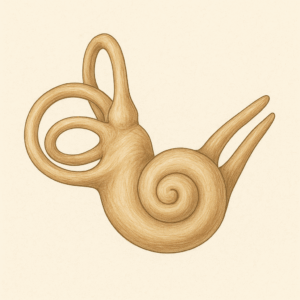
The inner ear consists of two main parts: the cochlea, which is responsible for hearing, and the vestibular system (vestibule and semicircular canals), which is responsible for balance.
The cochlea contains hair cells, which act as sensory receptors. They convert sound vibrations, sorted according to frequency, into electrical signals that are transmitted to the brain via the cochlear nerve. The brain then interprets these signals as sound.
Hair cells are extremely fragile and cannot regenerate. Their gradual or sudden loss leads to hearing loss. With age, their number naturally decreases: this is presbycusis, the auditory equivalent of presbyopia for vision.
They can also be destroyed by excessive exposure to noise. Below 80 dB, there is generally no risk. Above this level, exposure time must be limited, otherwise acoustic trauma may occur, leading to permanent hearing loss.
The vestibular system, located in the vestibule and semicircular canals, is essential for our balance. It contains a fluid called endolymph, whose movements stimulate specialized sensory cells. These cells send information via the vestibular nerve to help the brain perceive the position and movements of the body in space.